Giới thiệu
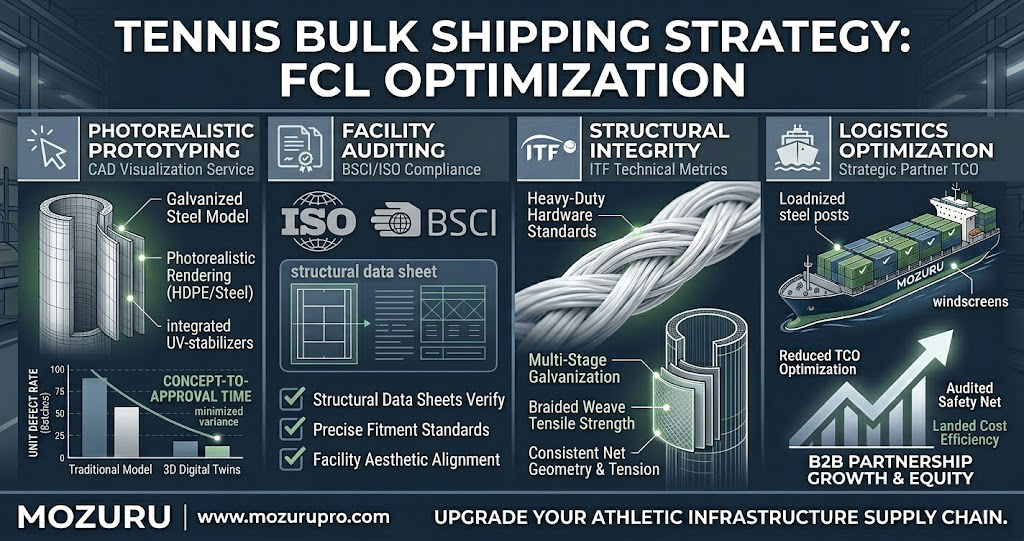
Implementing a strategic Tennis Bulk Shipping Strategy is a critical operational lever for modern athletic brand owners and international sporting goods distributors looking to secure their bottom-line margins in 2026. In large-scale cross-border commerce, true profitability is determined long before the merchandise hits the retail floor; it is won in the technical orchestration of freight cubic utilization and flawless customs tariff alignment.
When importing industrial-scale sports infrastructure—such as heavy-gauge steel tennis posts, braided high-density nets, and high-opacity windscreens—unoptimized cargo allocation and incorrect border documentation can instantly erode a distributor’s entire competitive advantage. This comprehensive operational blueprint delivers the cross-border mathematics and compliance insights required to maximize landed cost efficiency.
Mục lục
1. Volumetric Maximization: Advanced Algorithms for FCL Optimization
A data-driven tennis bulk shipping strategy prioritizes Full Container Load (FCL) over Less than Container Load (LCL) transport to insulate fragile hardware from frequent terminal handling and to capture bottom-tier ocean freight rates. However, achieving true cost-per-unit compression requires precise structural nested packing algorithms.
Because an international order often contains a mixed product portfolio—ranging from high-volume, lightweight custom windscreens to high-density, low-volume steel ground sleeves—random warehouse loading results in excessive "dead air" space. MOZURU’s engineering division utilizes dedicated 3D container-loading software to simulate the exact spatial arrangement inside a standard 40-foot High Cube (HC) container before final manufacturing clearance. By structurally nesting the tubular tennis post components alongside flexible net cartons, we regularly boost container cubic utilization coefficients up to 96%, dropping your amortization costs to historical lows.
2. Tariff Protection: Precise HS Code Classification Matrices
Customs clearance delays represent a catastrophic risk to supply chain liquidity. In the context of global customs enforcement, utilizing a precise HS code classification framework is the only line of defense against unexpected border seizures, punitive anti-dumping investigations, and miscalculated import duty evaluations.
Sporting goods hardware often falls into highly granular tariff subheadings that vary drastically by country of import. Misclassifying a galvanized structural steel tennis post under a generic steel tube category instead of the dedicated sports equipment heading (typically Chapter 95) can trigger extensive compliance audits.
| Equipment Profile | Primary Tariff Heading | Regulatory Focus Nodes |
| Heavy-Gauge Steel Posts | HS 9506.99 (Tennis Equipment) | Zinc Micron Coating Validation |
| Braided HDPE Netting | HS 9506.99 (Net Systems) | Tensile Strength Certifications |
| Custom Windscreens | HS 6307.90 (Made-Up Textile) | Core-Infused UV Inhibitor Audits |
| Precision Ground Sleeves | HS 7326.90 (Articles of Iron/Steel) | Anti-Rust Metallurgical Testing |
Our dedicated logistics export compliance desk ensures that every commercial invoice, bill of lading, and packing list features the exact verified harmonized code matched to the latest global customs updates, removing all operational friction at the port of entry.
3. Total Cost Compression: Expanding Landed Cost Efficiency
The ultimate metric of an optimized bulk sports equipment logistics workflow is the reduction of the Total Cost of Ownership (TCO). High freight prices cannot always be avoided, but incidental port expenses—such as demurrage fees caused by missing documentation or unexpected material handling charges—are completely within a manager's control.
By partnering with a structured manufacturer that supplies pre-sorted, container-optimized freight, distributors can transition away from reactionary logistics toward predictive inventory management, unlocking true landed cost efficiency and expanding wholesale distribution margins across all market networks.
4. Cohesive Framework: Syncing Prototyping with Fleet Logistics
To see how advanced transit preparation integrates with our overall design and validation protocols, explore our comprehensive Tennis Court Equipment Manufacturing Blueprint. Additionally, you can review our technical documentation on the Tennis 3D Design Workflow to discover how our digital twins allow our algorithms to simulate exact spatial container allocation weeks before ocean freight container booking occurs.
[REQUEST A LANDED COST LOGISTICS AUDIT]
Need a custom volumetric packing simulation for a 40ft HC container or a verified tariff classification review for a specific port? Click here to [Contact Our Global Logistics Engineering Team for a Freight Quote] today. Let our customs specialists optimize your bulk container allocation, tax exposure ratings, and global shipping pipelines.