Introduction: Not All Carbon Fiber is Created Equal
T700 Carbon Fiber Pickleball Paddles have quickly become the definitive standard for professional-grade performance. In the rapidly evolving world of competitive pickleball, the material specified on a paddle's spec sheet can be the difference between a high-margin premium asset and a low-quality liability. Among the various grades of composite materials, T700 Raw Carbon Fiber has emerged as the definitive standard for professional-grade performance. But for institutional buyers and sports club owners, the question remains: why does "material grade" dictate the success of a paddle line? At МОЗУРУ, we recognize that true longevity and player satisfaction are engineered at the molecular level, starting with the selection of aerospace-grade carbon fiber.
In this technical deep-dive, we explore the science behind T700 fibers, their superior fatigue resistance compared to traditional alternatives, and how the "raw" surface texture provides the ultimate competitive advantage for elite players and high-volume procurement programs.
Зміст
- The Science of T700: Tensile Strength and Modulus
- Fatigue Resistance: Why T700 Lasts 3x Longer
- The "Raw" Edge: Friction Coefficients and Spin Control
- B2B Procurement: Avoiding the "T300 Trap"
- The MOZURU Quality Control Standard
- Conclusion: Investing in Professional Longevity
The Science of T700: Tensile Strength and Modulus
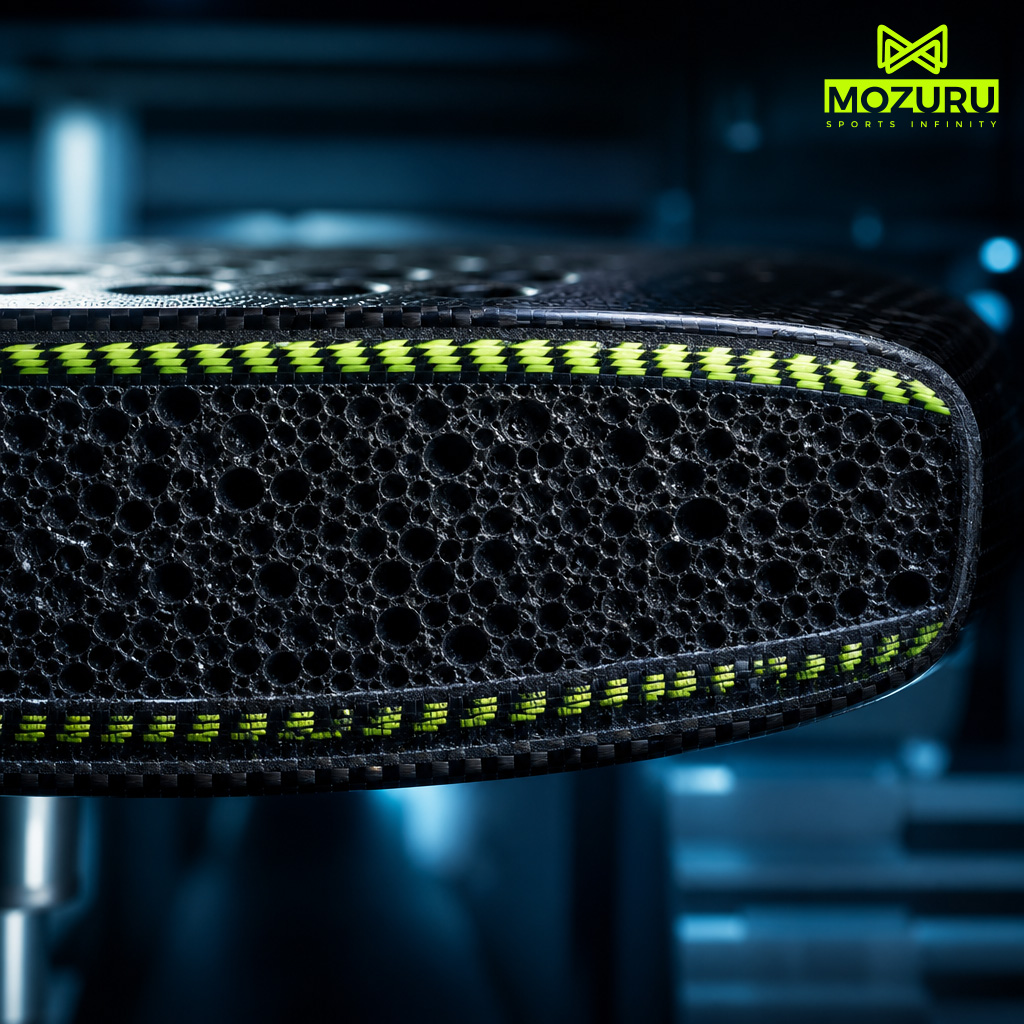
To understand the T700 advantage, we must look at the technical specifications defined by the manufacturer, Toray. T700 is classified as a "standard modulus" carbon fiber, but it boasts a significantly higher tensile strength (4,900 MPa) than the entry-level T300 or generic "graphite" faces used in mass-market paddles. This high tensile strength allows the paddle face to flex slightly during impact and return to its original shape with zero permanent deformation—a phenomenon known as high elastic recovery.
Why this matters for your inventory:
- Energy Return: Higher tensile strength translates to better "pop," allowing players to generate pace without additional swing effort.
- Structural Stability: T700 fibers provide a more rigid foundation for the honeycomb core, preventing the "dead spots" that develop in cheaper composite paddles after only a few months of play.
- Weight-to-Strength Ratio: MOZURU paddles utilize T700 to keep equipment lightweight for quick kitchen exchanges while maintaining the stiffness required for baseline power drives.
Fatigue Resistance: Why T700 Lasts 3x Longer
One of the biggest hidden costs for sports clubs and rental fleets is equipment fatigue, which is precisely why T700 Carbon Fiber Pickleball Paddles are the preferred choice for high-traffic facilities. A pickleball ball impacts the paddle face thousands of times per week. Over time, lower-grade fibers develop microscopic fractures that weaken the overall structure. T700 carbon fiber is engineered for aerospace applications, meaning it is designed to withstand millions of stress cycles without compromising its structural integrity.
When you source T700 Carbon Fiber Pickleball Paddles from MOZURU, you are choosing a product that resists delamination and face-softening, giving T700 Carbon Fiber Pickleball Paddles a decisive edge in demanding environments. While a standard fiberglass or T300 paddle may lose its "new" feel after 3 months of heavy club use, a T700 unibody paddle maintains its performance characteristics for over a year, effectively tripling the ROI on your equipment spend. For fleet operators who track cost-per-play, T700 Carbon Fiber Pickleball Paddles are the clear financial winner.
The "Raw" Edge: Friction Coefficients and Spin Control
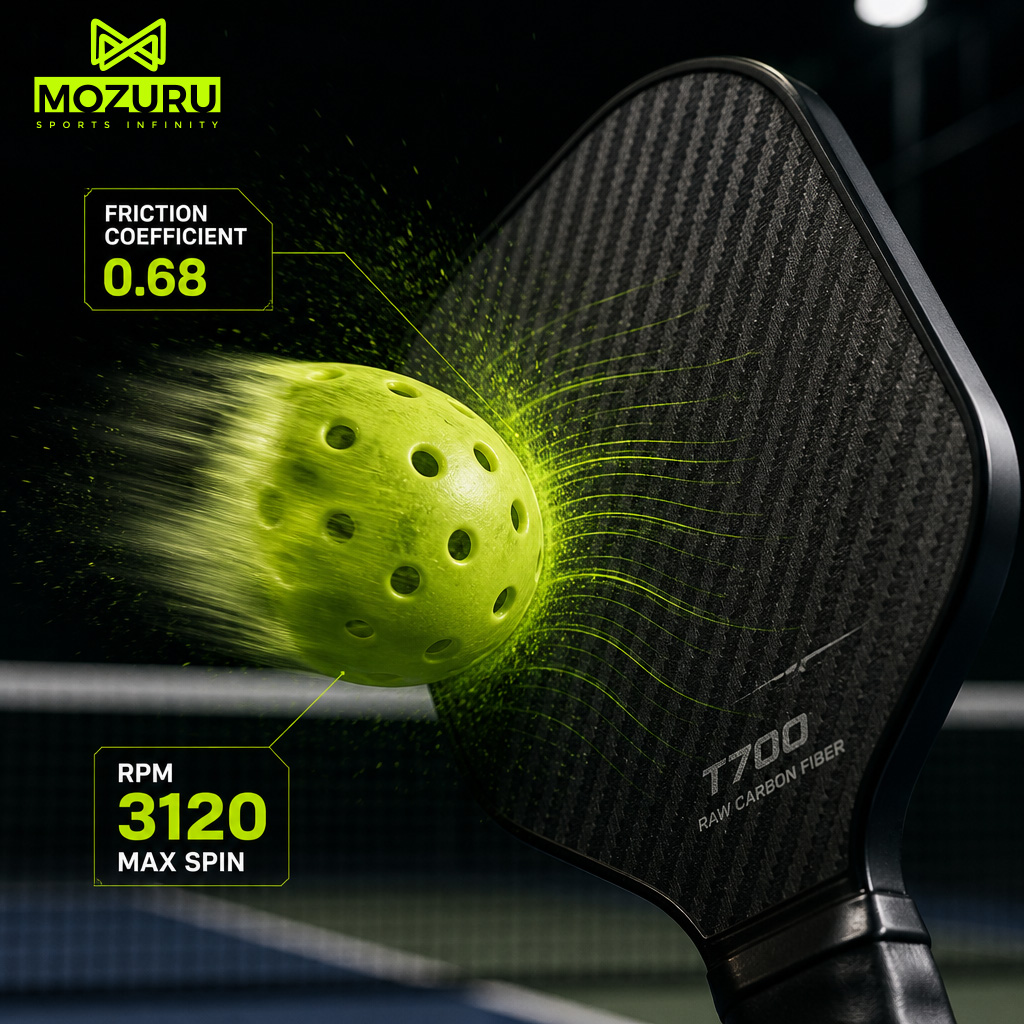
In modern pickleball, spin is the ultimate weapon. Traditional paddles achieve surface friction through "added grit"—silica or sand particles mixed into a top-coat paint. This added grit is temporary; it inevitably wears off, leaving a smooth, "illegal" surface that fails USAPA friction tests. Raw Carbon Fiber Surface technology eliminates this problem by using the natural texture of the T700 weave itself.
During the MOZURU thermoforming process, the T700 fibers are pressed into a specific pattern that creates a permanent, high-friction surface. Because this grit is part of the fiber structure, it doesn't flake off or smooth out. Professional players demand this consistency, and B2B distributors benefit from significantly lower return rates caused by "grit wear."
Technical Comparison: T700 vs. Entry-Level Composites
| Feature | MOZURU T700 Raw Carbon | Standard T300 / Fiberglass |
|---|---|---|
| Tensile Strength | 4,900 MPa (Aerospace Grade) | ~3,500 MPa (Industrial Grade) |
| Surface Texture | Permanent Raw Weave | Temporary Grit Top-coat |
| Fatigue Life | Elite (12-18 months commercial) | Moderate (3-6 months commercial) |
| Sweet Spot Response | Consistent (High Modulus) | Deteriorates over time |
B2B Procurement: Avoiding the "T300 Trap"
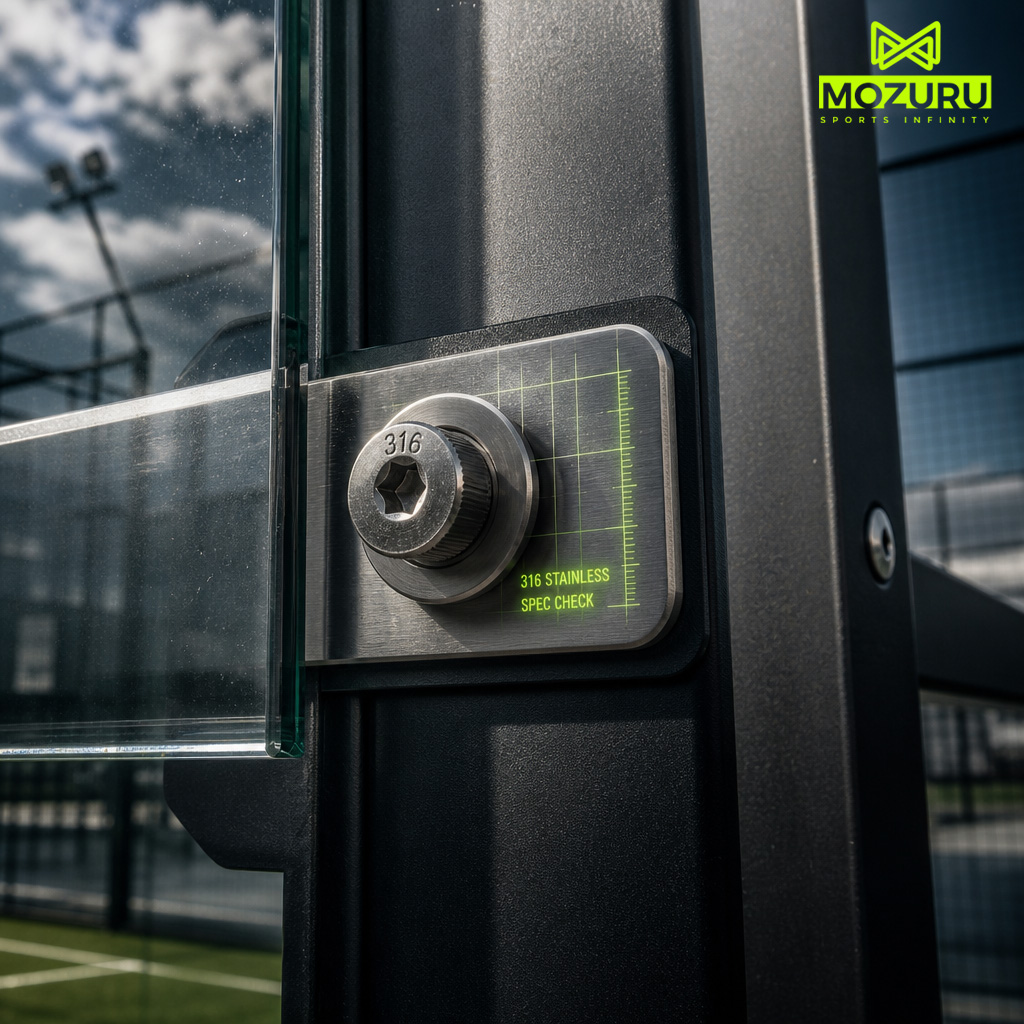
For procurement managers, a common challenge is the lack of transparency in the supply chain. Many suppliers claim to use "Carbon Fiber" but substitute T300 or standard graphite to lower manufacturing costs. When you source T700 Carbon Fiber Pickleball Paddles, every batch ships with verifiable material documentation. While the paddles may look identical in a photo, the performance gap becomes evident within weeks of delivery. To ensure your brand or club is offering the best, always verify the material source. MOZURU works exclusively with Toray Carbon Fibers to guarantee that our T700 claims are backed by physical material certificates, so your T700 Carbon Fiber Pickleball Paddles orders carry full traceability from fiber to finished paddle.
Furthermore, our manufacturing line is optimized for Private-Label and Wholesale orders of T700 Carbon Fiber Pickleball Paddles, providing the necessary documentation for USAPA certification and international safety standards.
The MOZURU Quality Control Standard
Our commitment to material grade is supported by a rigorous quality control pipeline. Every batch of T700 fiber undergoes tensile testing before it enters our thermoforming molds. By maintaining vertical integration, MOZURU ensures:
- Fiber Orientation Precision: We align the carbon weave to maximize the friction coefficient based on ball impact angles.
- Resin Consistency: Our epoxy resin systems are specifically formulated to bond with T700 fibers without clogging the raw surface texture.
- Batch Traceability: Every wholesale order is logged with its material origin data, ensuring consistent quality across years of production.
Conclusion: Investing in Professional Longevity
In the professional pickleball landscape, quality is a strategy, not an accident. T700 carbon fiber is the foundation upon which elite performance and long-term ROI are built, and it is why T700 Carbon Fiber Pickleball Paddles lead every category we test. As the market matures, players and buyers alike are becoming more discerning about "what is under the hood." By choosing MOZURU's T700 raw carbon fiber paddles, you are investing in a product that defines the industry standard for durability, spin, and power. From competitive leagues to rental fleets, T700 Carbon Fiber Pickleball Paddles deliver the consistency serious buyers rely on.
Upgrade your equipment standards with T700 Carbon Fiber Pickleball Paddles today. Learn more about MOZURU materials or request a durability report for your facility.