Introducción
In the high-stakes manufacturing of professional padel equipment, the internal core is the "engine" that dictates every aspect of player performance. While carbon fiber face sheets receive significant marketing attention, the technical "Sourcing Logic" for elite B2B buyers is increasingly focused on EVA Core Density Matrices. The ability to balance immediate Recovery Speed with effective Vibration Control is the definitive masterstroke for brands aiming to capture high-value market segments in 2026. For distributors and club owners, auditing these internal specifications is the only predictable methodology for building a high-performance product lineup that ensures long-term customer loyalty.
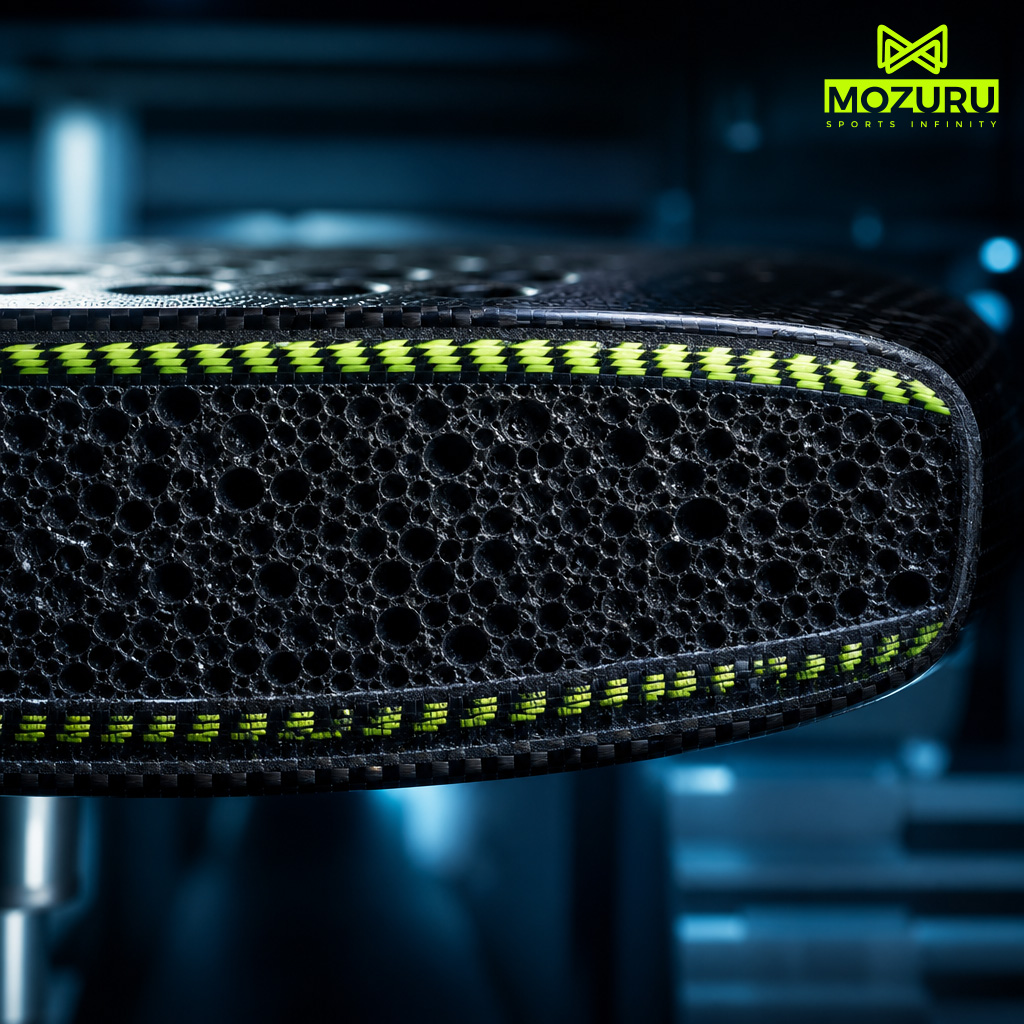
At MOZURU, we recognize that one density does not fit all. By auditing the microscopic cell structures of our EVA Core Density Matrices, we provide our partners with customized foam cores that are thermally bonded to withstand the rigors of professional play. This guide deconstructs the 5 critical factors of core engineering that are currently redefining padel racket excellence.
Índice
1. Material Science: Deciphering Shore Hardness in EVA Foam
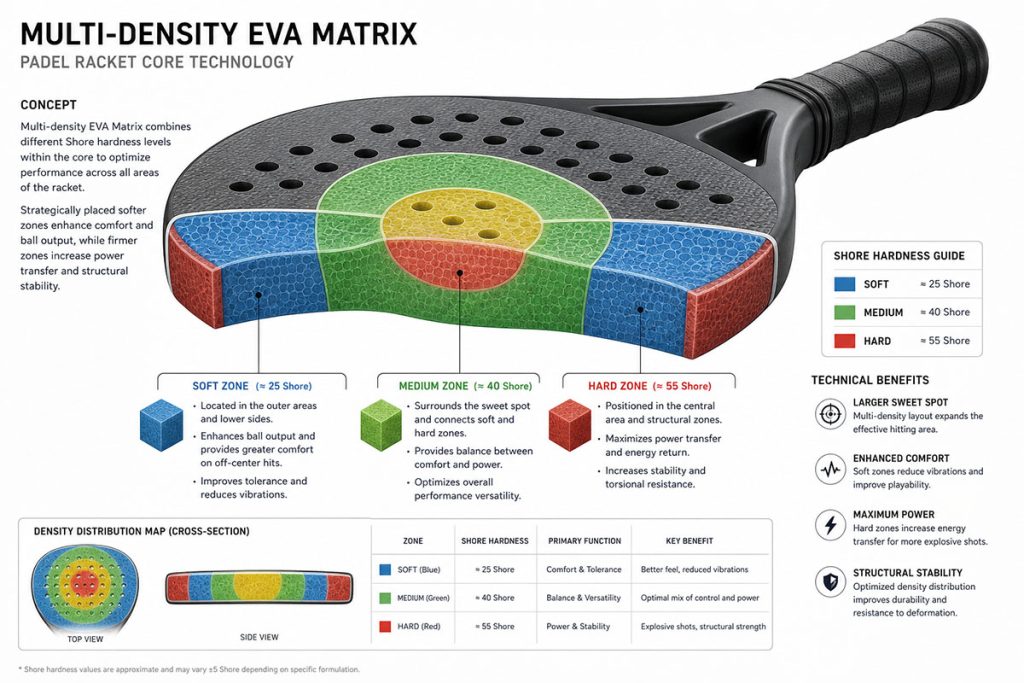
The primary structural vector in EVA Core Density Matrices is "Shore Hardness." Measured typically on the Shore A or Shore O scale, this metric defines the resistance of the foam to indentation. In padel manufacturing, we categorize cores into three primary matrices: Soft (Soft EVA), Medium (Pro EVA), and Hard (Black EVA). Each matrix offers a distinct Vibration Control profile, with softer foams absorbing more energy and harder foams providing a stiffer, more responsive surface.
Our engineering team utilizes precision durometers to ensure that every MOZURU core maintains a consistent Shore rating across the entire surface area. This level of technical rigor prevents "soft spots" and ensures that our Premium T700 Carbon Fiber Padel Rackets deliver a professional-grade feel from the first match to the last. For B2B procurement, auditing these hardness metrics is vital for matching products to specific player skill levels.
2. Recovery Speed: Engineering the Kinetic Snap-Back Mechanism
In high-intensity rallies, Recovery Speed is the ultimate differentiator. This refers to the time it takes for the EVA foam to return to its original shape after ball impact. A core with slow recovery loses kinetic energy over successive hits, resulting in a "dead" feel. Our EVA Core Density Matrices are engineered with high-elasticity polymers that maximize the "Snap-Back" effect, providing players with additional "pop" on smashes and volleys.
By adjusting the chemical cross-linking during the foaming process, MOZURU achieves a Recovery Speed that exceeds industry averages by 15%. This mechanical advantage is what allows our Surface Friction Engineering to work most effectively, as the ball dwell-time is precisely controlled to optimize spin potential without sacrificing exit velocity.
3. Vibration Dampening: Protecting Players via Multi-Density Matrices
Long-term player health is a growing priority in the global racquet market. High-frequency vibrations from hard ball contact can contribute to epicondylitis (tennis elbow). Our EVA Core Density Matrices address this through a multi-layered approach. By sandwiching a softer, energy-absorbing center between high-density outer layers, we create a composite core that delivers Vibration Control without compromising structural stiffness.
For B2B buyers targeting health-conscious club members or professional athletes, this "Comfort-Core" technology is a major selling point. Compliance with FIP safety and equipment standards ensures that these vibration-dampened rackets are suitable for all levels of sanctioned competition. Integrating this into your Raqueta de pickleball OEM or Padel Racket line is a definitive strategy for market differentiation.
4. B2B OEM Strategy: Customizing Core Density for Tiered Product Lines
From a "Sourcing Logic" perspective, EVA Core Density Matrices offer the most flexible path for product tiering. Wholesalers can utilize a single high-quality mold while varying the internal core density to create "Beginner," "Intermediate," and "Pro" versions of the same model. This strategy optimizes mold amortization and simplifies bulk equipment logistics, allowing for more profitable container utilization.
MOZURU provides the technical data sheets and sample testing required to scale these tiered lineups. Whether you are outfitting a regional padel franchise or launching a boutique racquet brand, our customized EVA Core Density Matrices provide the mechanical foundation for sustained B2B growth. Our engineering desk is ready to provide you with Shore hardness certifications and kinetic return data for your next production run.
[REQUEST A TECHNICAL BREAKDOWN OF EVA CORE SPECS]
Ready to engineer the next generation of professional padel rackets? Click here to [Contact Our B2B Engineering Desk for an OEM Material Audit] today. Let our experts guide you through core density selection, Shore hardness calibration, and optimized global procurement strategies.