Introduktion
For international B2B distributors and volume procurement officers, analyzing the underlying engineering phase of sports equipment is the single most accurate metric for qualifying high-value manufacturing partners. In 2026, global marketplace competition has fundamentally migrated away from basic "low-cost" positioning. Instead, international purchasing power is driven heavily by manufacturing consistency, structural longevity, and true batch uniformity.
As a technologically advanced thermoformed pickleball paddles manufacturer, MOZURU implements highly automated thermal press systems to eradicate common defects and elevate product quality. To understand how these manufacturing standards fit into macro market procurement and consumer demographics, we highly advise reviewing our strategic breakdown of the Rapport om det globale pickleball-marked 2026 before finalizing your next factory tooling layout.
Indholdsfortegnelse
1. The Design Phase: Digitally Driven Performance and Stress Simulation
At the MOZURU R&D center, industrial paddle design extends far beyond superficial aesthetic graphics. Every premium mold configuration undergoes a rigorous digital validation sequence prior to physical manufacturing.
Instant 3D Visualization and Prototyping
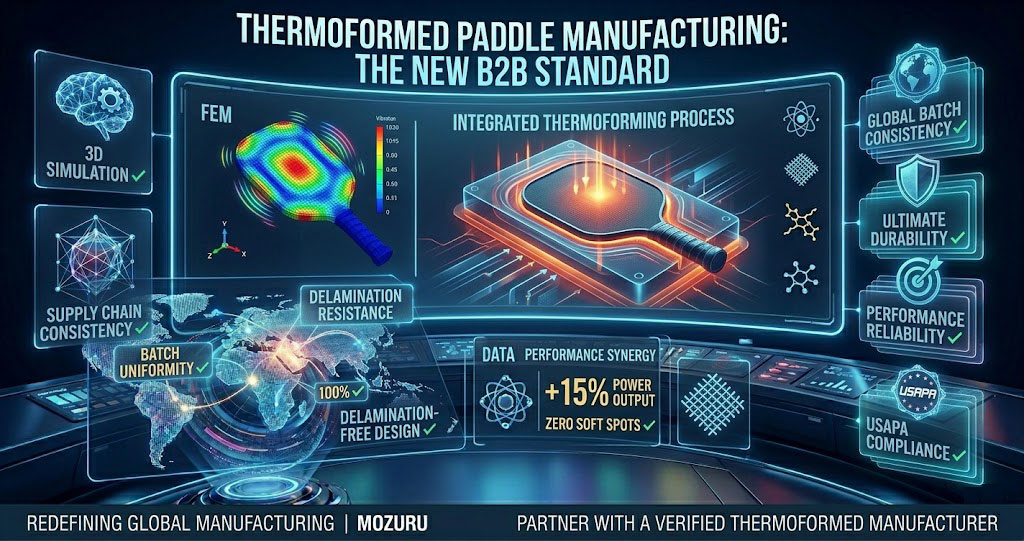
Our engineering department utilizes professional tools like Blender and KeyShot to construct high-fidelity 3D rendering profiles for our OEM/ODM clients. Before a physical mold is machined, B2B wholesale buyers can inspect precise logo alignment, microscopic raw face textures, and accurate volumetric proportions. This rapid digital prototyping eliminates communication bottlenecks and dramatically reduces bulk sampling turnaround times.
Finite Element Method (FEM) Stress Simulation
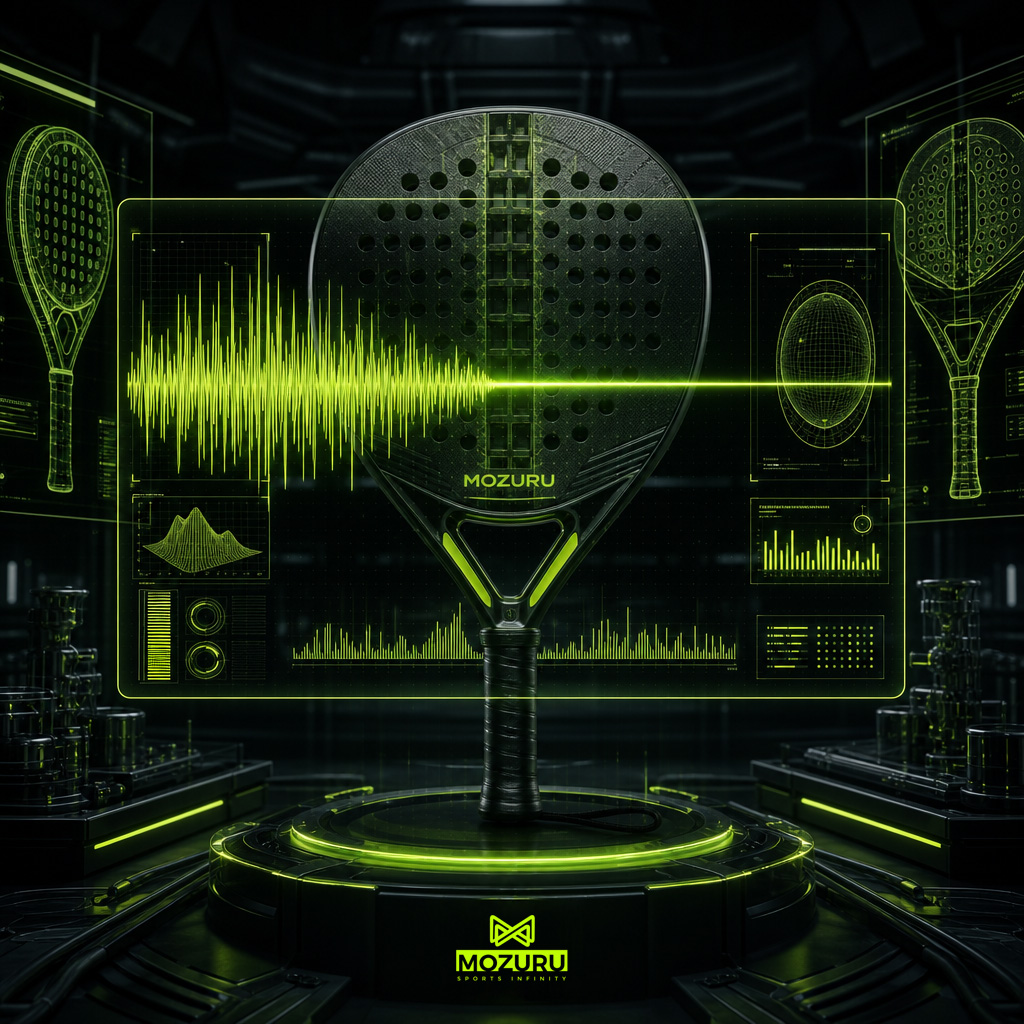
We conduct specialized stress simulation profiling to analyze the propagation of vibration waves during high-velocity impacts. By mapping internal stress concentrations, our team can systematically adjust the core density distribution. This allows us to customize exclusive unibody molds tailored perfectly for a brand's specific "power-oriented" or "control-focused" target market catalog.
2. Core Manufacturing Tech: Thermoforming vs. Cold Press Systems
The thermal molding method serves as the definitive technical line dividing premium competition-grade instruments from low-tier recreational products.
Understanding these mechanical parameters is crucial when evaluating a prospective thermoformed pickleball paddles manufacturer:
| Structural Metric | Traditional Cold Press Systems | MOZURU Integrated Thermoforming |
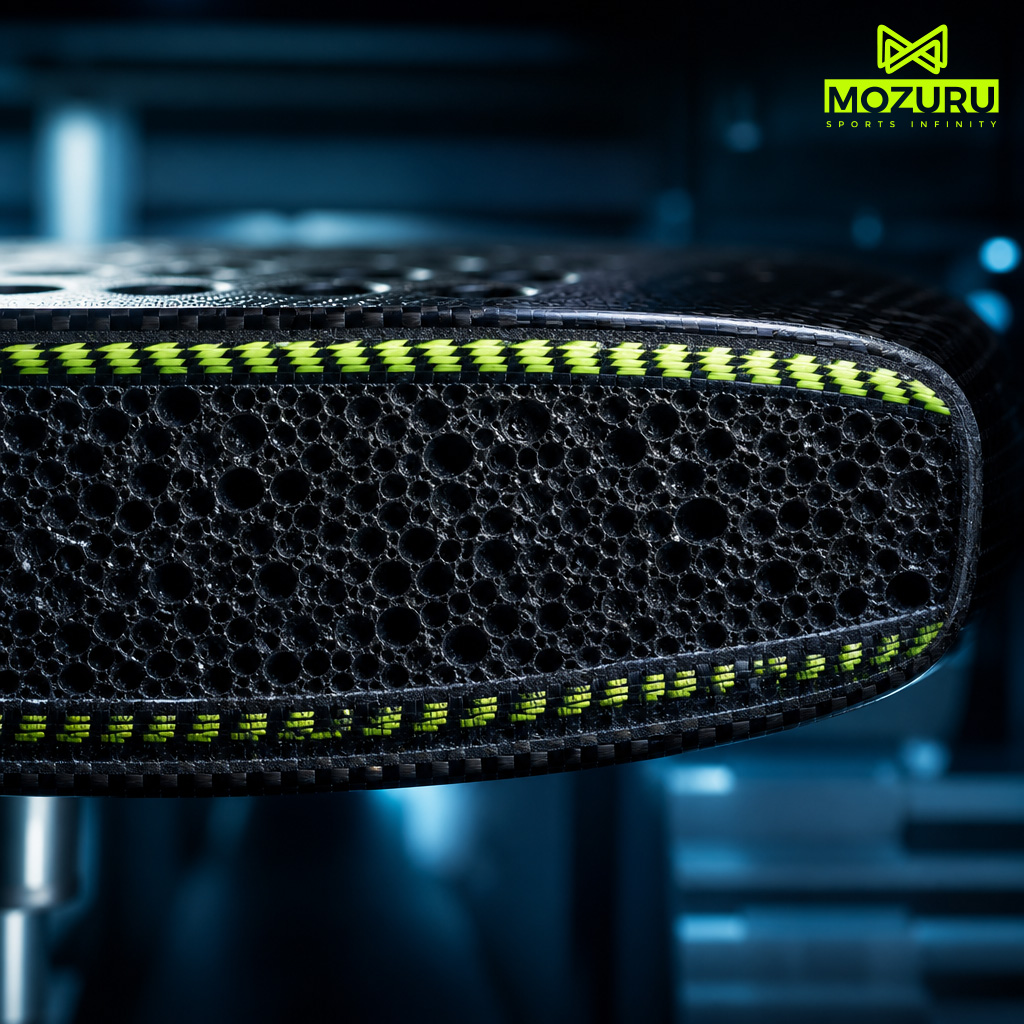
| Edge Treatment | Face sheets simply glued to core; prone to perimeter cracking. | Carbon-Wrapped Edge sealed completely inside the mold. |
| Perimeter Reinforcement | None; relies entirely on external plastic edge guards. | Foam Injected Edge for maximum twist weight stability. |
| Energy Transfer | Mechanical energy loss due to adhesive dampening; softer feel. | Seamless unibody integration; +15% Kinetic Power Output. |
| Delamination Rate | High risk of core-face separation after 3-6 months of intense play. | Delamination-Free Design backed by high-pressure resin curing. |
| Batch Consistency | Varied weight and thickness due to manual glue application layers. | Automated thermal press machinery ensuring absolute uniformity. |
3. Surface Friction Engineering: The Science of High-RPM Spin
The USA Pickleball-foreningen enforces strict regulatory thresholds regarding surface roughness and grit degradation. The true engineering challenge lies in maximizing spin potential while maintaining total compliance over extended product lifecycles.
Dynamic Friction Coefficient Optimization
Our materials team studies the static and dynamic friction coefficients of specialized face composites under high load forces. Rather than applying cheap, post-production texture coatings that quickly erode, our processing press imprints a continuous microscopic texture directly into the raw Toray T700 carbon fiber matrix. This precise micro-structure extends ball dwell time on the paddle face, optimizing rotational velocity during competitive play.
Wear-Resistant Microstructure Longevity
Traditional spray-on grit finishes flatten out after only a few weeks of intensive play, leading to rapid performance decay and customer complaints. Because MOZURU integrates the abrasive profiling directly into the carbon fiber weave structure, the paddle retains exceptional spin capabilities even after severe surface wear, ensuring high consumer satisfaction for your distributed brand.
4. Conclusion: Advanced Manufacturing Process as Your B2B Moat
Partnering with an R&D-driven thermoformed pickleball paddles manufacturer provides your distribution company with a powerful, long-term commercial moat:
- Drastic Reduction in Warranty Claim Costs: Transitioning to a certified delamination-free construction method means your distribution network no longer suffers from expensive returns and product quality complaints.
- Elevated Brand Premium Space: By utilizing professional 3D stress visualization diagrams and thermoformed technical documentation, your sales team can easily justify higher premium pricing tiers to retail dealers.
- Massive Volume Consistency: Our fully automated thermoforming production floor ensures that the 1st paddle and the 10,000th paddle feature the exact same weight, center of gravity, and responsive hand feel.
[ACCESS FACTORY TECH VIDEO]
Want to view our automated thermoforming line in action or access full engineering CAD data? Click here to [Contact Our Engineers for Technical Documentation] today and secure a competitive edge for your product line.