Introduction: The Silent Engine of Padel Performance
In the professional world of padel, a racket's outward aesthetics often overshadow its most critical component: the internal core. For club operators, elite players, and B2B procurement managers, understanding EVA Core Dynamics is essential for selecting gear that balances explosive power with long-term player comfort. The density of the Ethylene Vinyl Acetate (EVA) foam dictates every measurable performance metric—from the ball's recovery speed off the face to the amount of harmful vibration transmitted to a player’s elbow. At মোজুুরু, we view the racket core as a precision-engineered engine, utilizing advanced manufacturing to tune the EVA Core Dynamics for various playstyles and commercial environments.
In this technical deep-dive, we explore how material density influences playability, why high-recovery foam is the industry's new standard, and how mastering EVA Core Dynamics can lead to proven success for your sports brand or facility. Whether you are stocking a pro-shop or launching an OEM line, the science "under the hood" matters most. For the sport's official equipment standards, consult the International Padel Federation (FIP).
সূচিপত্র
- The Physics of EVA: Soft vs. Hard Foam Density
- Recovery Speed: The "Trampoline Effect" in Professional Gear
- Vibration Dampening: Protecting Players with Core Engineering
- Technical Matrix: Matching Density to Playstyles
- Durability and ROI: Preventing Core Softening in Bulk Fleets
- The MOZURU Precision Core Sourcing Advantage
- Conclusion: Future-Proofing Your Padel Inventory
The Physics of EVA: Soft vs. Hard Foam Density
The foundation of EVA Core Dynamics lies in the density measurement, typically ranging from "Soft" (EVA 10-13) to "Hard" (EVA 30+). For institutional buyers, choosing the right density is a strategic decision that depends on the target user's skill level. A soft core provides more "feel" and ball dwell-time, making it ideal for club members and intermediate players who require a larger sweet spot. Conversely, high-density hard cores are designed for professional hitters who generate their own power and require zero energy loss during high-speed exchanges.
Strategic Density Classification:
- Soft EVA (Elastic): Maximizes comfort and reduces the risk of injury. EVA Core Dynamics in soft models focus on high ball exit speed at low swing weights.
- Hard EVA (High-Modulus): Provides surgical precision and maximum power return for advanced players. Hard EVA Core Dynamics prioritize structural rigidity under heavy impact.
Recovery Speed: The "Trampoline Effect" in Professional Gear
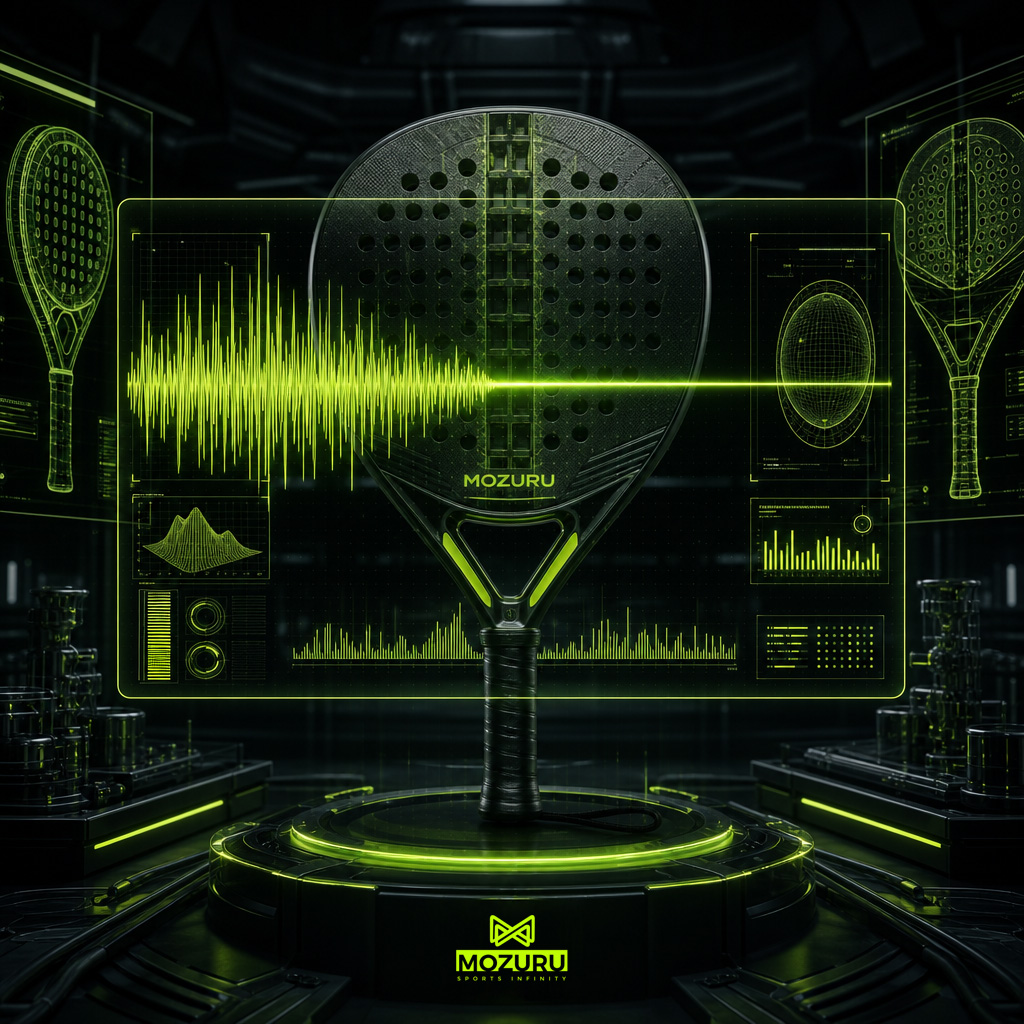
A critical factor in EVA Core Dynamics is the memory—or recovery speed—of the foam. When a padel ball impacts the racket, the EVA foam compresses and then rapidly expands to propel the ball. If the recovery is too slow, the racket feels "mushy," leading to inconsistent shots. Premium MOZURU rackets utilize "High-Recovery EVA," which returns to its original shape in milliseconds. This superior EVA Core Dynamics profile ensures that even during rapid-fire kitchen volleys, the racket face remains reactive and predictable.
Vibration Dampening: Protecting Players with Core Engineering
Safety and comfort are the cornerstones of successful club management. Repetitive vibration from poorly engineered cores is a leading cause of "Padel Elbow." Advanced EVA Core Dynamics use foam cells to trap and dissipate kinetic energy before it reaches the handle. By sourcing equipment with optimized EVA Core Dynamics, you are effectively protecting your members and reducing the physical fatigue associated with long tournament sessions.
Technical Matrix: Matching Density to Playstyles
| Metric | Soft EVA (13-17 Density) | Hard EVA (28-35 Density) |
|---|---|---|
| Energy Recovery | Moderate (High Feel) | Elite (Maximum Pop) |
| Vibration Dampening | Superior | Moderate |
| Durability Score | Good (prone to softening) | Exceptional |
| Sweet Spot Width | Very Wide | Precision-Centered |
Durability and ROI: Preventing Core Softening in Bulk Fleets
For B2B distributors and rental fleets, the enemy is "core softening"—when the EVA Core Dynamics degrade after heavy use, leaving the racket permanently dead. Low-quality foam uses large, inconsistent cells that collapse over time. MOZURU’s EVA Core Dynamics utilize micro-cell injection, ensuring that the density remains uniform across thousands of hits. Investing in rackets with professional-grade EVA Core Dynamics triples your equipment's lifespan, providing a massive boost to your long-term ROI. Every wholesale order of EVA Core Dynamics gear from MOZURU is backed by rigorous fatigue-testing data.
The MOZURU Precision Core Sourcing Advantage
We differentiate our manufacturing through a "Core-First" engineering philosophy. By controlling the EVA formulation and the vacuum-bonding process in-house, MOZURU offers:
- Density Precision: We maintain a +/- 1% tolerance on all EVA Core Dynamics batches.
- Multi-Layer Fusion: Our cores are bonded to T700 carbon fiber faces using proprietary heat cycles to enhance EVA Core Dynamics responsiveness.
- Thermal Stability: MOZURU's EVA Core Dynamics are tested for performance consistency in temperatures from 5°C to 45°C.
Conclusion: Future-Proofing Your Padel Inventory
As the padel market continues its rapid expansion, the sophistication of player demands is increasing. EVA Core Dynamics is no longer a hidden spec; it is the primary driver of performance and safety. By choosing MOZURU as your manufacturing partner, you are ensuring that your brand or club stays ahead of the technical curve. Mastering EVA Core Dynamics is the single most important step in building a high-performance, high-longevity racket line.
Ready to upgrade your racket technology? [Explore our core manufacturing process](https://www.mozurupro.com/about/) or request a technical density report for your next B2B wholesale order.